A detailed sharing of the efficient and non-damaging ultrasonic cleaning process for chalcogenide glass IRG206 (Se-As system), including its characteristics, cleaning difficulties, removal mechanisms of silica and alumina polishing residues, and the full cleaning procedure based on Luhui Technology's special cleaning agent, aiming to solve the key bottleneck of IRG206 cleaning in infrared optical production.
With the rapid advancement of infrared imaging and detection technologies, traditional infrared materials such as single-crystal cerium and single-crystal germanium deliver excellent performance. However, their high cost and difficult machinability have restricted their popularization in civil applications.
As an amorphous infrared optical material, chalcogenide glass features broad spectral transmittance (especially in the 8–12 μm long-wave infrared band), outstanding athermalization performance, and superior suitability for precision molding. It has become a preferred material in fields including vehicle night vision, security surveillance, and industrial temperature measurement, earning the reputation as the "black gold" in the infrared optics industry.
In the product portfolio of world-leading material manufacturers such as SCHOTT, IRG206 (Se-As system) is a highly representative grade of chalcogenide glass. It boasts an extremely wide transparent wavelength range of 1–12 μm and excellent molding compatibility.
Nevertheless, due to its special chemical composition and physical properties — including soft texture, brittleness, and high susceptibility to oxidation — cleaning has become a critical bottleneck restricting its final optical performance and production yield throughout the entire manufacturing lifecycle. This spans from cold working (lapping and polishing) and coating to final system assembly.
This paper conducts an in-depth discussion on the characteristics of IRG206 chalcogenide glass, analyzes the scientific mechanism of polishing residue removal, and focuses on sharing an efficient and non-damaging cleaning process tailored for residues from silica and alumina polishing slurries.
1. In-depth Microcosmic Analysis: Characteristics and Cleaning Difficulties of IRG206
The grade IRG206 generally corresponds to an amorphous network structure with the chemical composition of As₄₀Se₆₀. Unlike traditional oxide glass, it is formed by covalent bonding between Group VIA elements (S, Se, Te) and metalloid elements such as arsenic (As), germanium (Ge), and antimony (Sb).
This unique chemical bonding and amorphous structure endow it with excellent infrared transmittance, while also bringing intractable cleaning challenges:
1. Physical Properties: Delicate Surface
IRG206 has a remarkably lower hardness than germanium single crystal or ZnSe polycrystal, and its glass transition temperature (Tg) is only about 180℃. This means that during cleaning, any mechanical contact (wiping, high-pressure spraying) or excessive temperature shock can easily cause micro-scratches, edge chipping or surface devitrification on the polished surface. Therefore, the cleaning process must be mild and non-contact.
2. Chemical Properties: Oxidation Tendency and Acid-Alkali Sensitivity
Although chalcogenide glass is insoluble in water, its surface is prone to slow oxidation and hydrolysis when exposed to air, forming a dense oxide layer or resulting in surface haziness. More importantly, IRG206 is extremely sensitive to strong alkalis, which will cause severe surface etching and completely damage the polished surface figure.
3. Core Contaminants: Stubborn Polishing Residues
To achieve high surface figure accuracy of infrared optical elements, IRG206 is usually ultra-precision polished with silica (SiO₂) or alumina (Al₂O₃) polishing slurry. The most stubborn challenge faced by the cleaning process is not oil stains or fingerprints, but the nanoscale polishing particles that agglomerate and embed into the micro-gaps of the glass lattice, together with residual organic carriers.
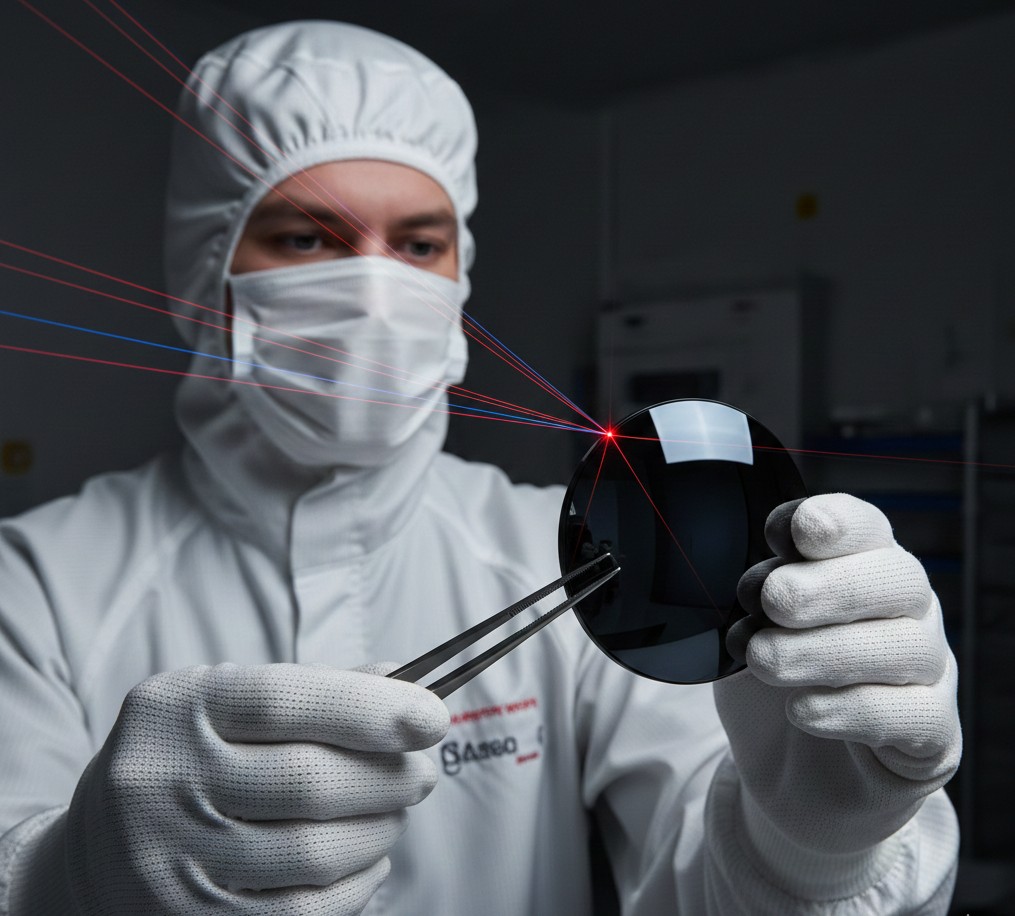
II. Scientific Residue Removal: Removal Mechanism of Silica and Alumina Polishing Slurries
Traditional methods for removing residual SiO₂ and Al₂O₃ polishing particles on IRG206 surfaces either rely excessively on the mechanical energy of ultrasonic waves (prone to damaging soft glass by vibration) or adopt strong acids and strong alkalis for chemical cleaning (likely to corrode the substrate). The core of efficient and damage-free cleaning lies in the balanced matching of chemical and physical energy.
1. Removal Mechanism of Silica (SiO₂, Silica Sol)
Silica sol polishing slurries mainly function by physical ploughing and interfacial chemical reactions. After drying, SiO₂ particles firmly adhere to the glass surface via hydrogen bonds.
The infrared dedicated cleaning agent from Luhui Technology adopts specialized chelating and emulsification technologies to introduce specific functional groups into the cleaning solution. These functional groups rapidly adsorb onto the surface of SiO₂ particles, reduce the interfacial tension between particles and the glass substrate, and meanwhile encapsulate agglomerated particles. Combined with mild dual-frequency ultrasonic waves, acoustic cavitation effect pulls particles away from the substrate surface into the liquid and prevents their re-deposition.
2. Removal Mechanism of Alumina (Al₂O₃)
Al₂O₃ particles feature high hardness and stronger lattice embedding tendency. Traditional acid or alkaline cleaning solutions for alumina removal are highly likely to damage the IRG206 substrate and subsequent anti-reflection coating layers.
A dedicated cleaning agent needs not only to adjust the environmental pH value to modify the surface potential of both the glass substrate and Al₂O₃ particles, but also to possess powerful dispersion capacity. Surfactant molecules form a temporary protective film on the substrate surface, reduce the agglomeration degree of Al₂O₃ particles to keep them in a loosely suspended state, so that the particles can be thoroughly washed away by pure water rinsing in the end.
III. Process Sharing: Dedicated Ultrasonic Cleaning Procedure for IRG206
In view of the physical characteristics of IRG206 and types of contaminants, the infrared lens dedicated cleaning agent series developed by Xiamen Luhui Technology can efficiently remove stubborn silica and alumina polishing slurry residues without using strong acids or strong alkalis and without substrate etching.
The optimized high-efficiency process is shared as follows (taking a multi-tank ultrasonic cleaning machine as an example):
Process Overview
Pre-cleaning → Main chemical cleaning → Overflow pure water rinsing → Dual-frequency pure water rinsing → Isopropanol dehydration (slow lifting) → Air knife drying.
